

Physiotherapy
HYROX Injuries Station by Station: A Physiotherapist’s Guide
Nov
HYROX mixes 8km of running with 8 strength and conditioning stations. Most injuries do not come from one big moment. They come from doing heavy, repetitive movements when you are already tired, so your form slips a little more with every station.
With HYROX Singapore on 26 to 29 November, and the Singapore International Marathon the following weekend, this guide goes through each station: what tends to get sore, and one simple fix for each.
- The lower back, knees, calves and Achilles, and shoulders take most of the load in HYROX.
- Most problems come from fatigue changing your technique, not from the weights themselves.
- In race week, cut your training volume, keep a little intensity, and do not try anything new.
- General soreness for 2 to 3 days is normal. Sharp pain in one spot, swelling, or pain that changes how you move needs a check.
The race at a glance
Every HYROX race follows the same order: a 1km run, then a station, repeated 8 times. That means you arrive at each station with your heart rate high and your legs already tired, which is when technique matters most.
Station by station: what gets sore and how to protect it
| Station | Common problem areas | One fix |
|---|---|---|
| Running (8 x 1km) | Calves, Achilles, shins, knees | Shorten your stride and keep a quick cadence for the first 200m after each station, while your legs “find” running again. |
| 1. SkiErg | Shoulders, lower back | Hinge at the hips with a flat back and pull with your lats and core, not just your arms. |
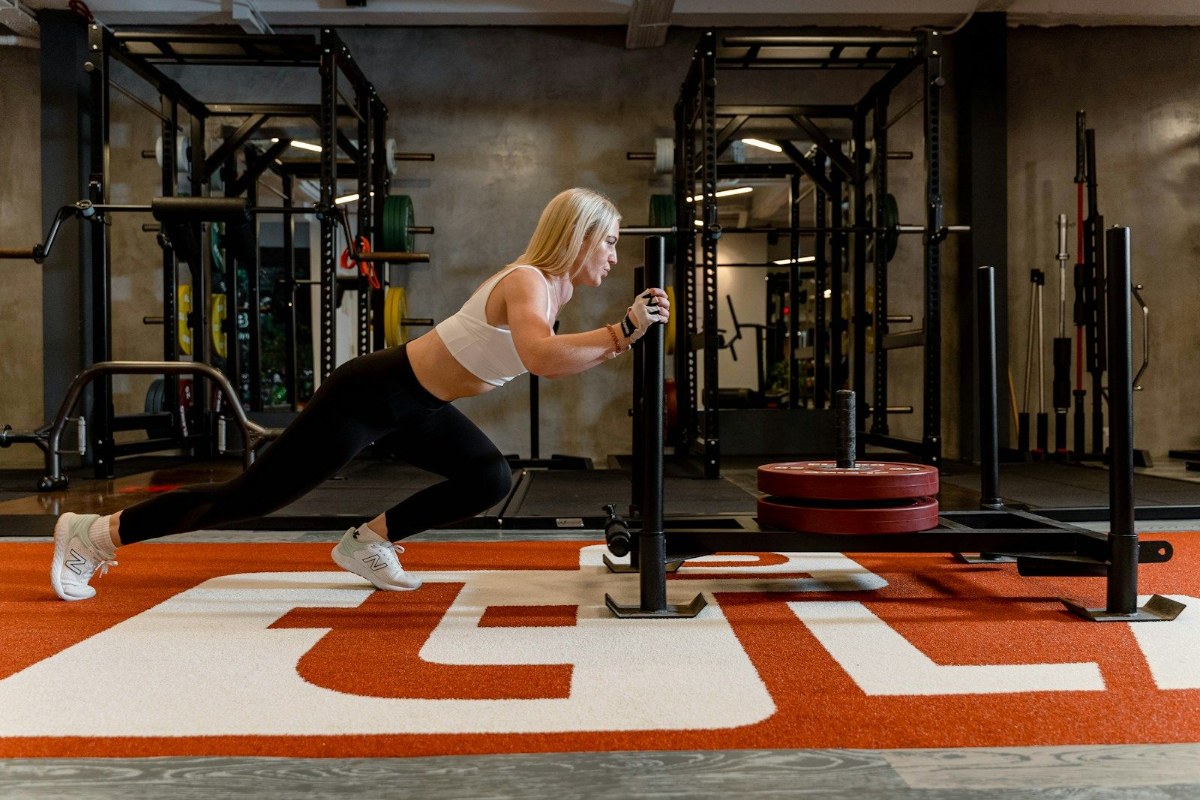
| 2. Sled push | Calves, Achilles, lower back | Keep your arms straight and your back flat, and take short, quick steps. Avoid arching your lower back to force the sled forward. |
| 3. Sled pull | Lower back, forearms, biceps | Sit back into a low stance and drive with your legs as you pull hand over hand. Do not round your back and yank with your arms. |
| 4. Burpee broad jumps | Wrists, knees, lower back | Land softly with your knees bent and over your toes. Step back out of the burpee if your jumps are getting sloppy. |
| 5. Rowing | Lower back | Push with your legs first, then lean back, then pull. Rounding your back at the end of the row is the classic way to strain it. |
| 6. Farmers carry | Grip, forearms, neck and upper back | Stand tall with your shoulders down and back. Put the handles down briefly before your grip fails, rather than dropping them awkwardly. |
| 7. Sandbag lunges | Front of the knee, hip flexors | Keep your front knee in line with your toes and your chest up. A slightly longer step takes pressure off the knee. |
| 8. Wall balls | Shoulders, knees, lower back | Squat with control and use your legs to drive the ball up. Break into short sets early instead of grinding through with poor form. |
The four injuries we see most
1. Lower back strain
The sled push and pull, rowing and wall balls all load the lower back, and fatigue makes it easy to lose a neutral spine. It usually feels like a tight, aching band across the lower back that is worse when bending. Most strains settle within 1 to 2 weeks with gentle movement (see acute low back pain). If you also lift in the gym, see our guide to lower back pain after deadlifts, which covers the same hip-hinge fixes.
2. Calf strain and Achilles pain
Sled pushing on the balls of your feet, plus 8km of running, puts a lot of load through the calves. A calf strain often feels like a sudden “kick” or sharp pain in the calf. Achilles pain builds up gradually and is usually worst first thing in the morning. Read more about Achilles tendon pain.
3. Knee pain at the front of the knee
Lunges, wall ball squats and burpee jumps all load the front of the knee. Pain around or below the kneecap that is worse on stairs or squatting is common, and usually responds well to strengthening the hips and thighs.
4. Shoulder irritation
The SkiErg and wall balls involve many repeated overhead and pulling movements. Pain at the front or side of the shoulder when lifting your arm overhead is a sign the shoulder needs a break and some targeted strengthening. See shoulder pain.
Race week: what to do now
- Taper. Cut your training volume by about half this week, with a few short, sharp efforts to stay sharp.
- Nothing new. No new shoes, new supplements or new exercises in race week.
- Practise transitions. A few easy runs straight after a short station (such as 10 lunges) help your legs adapt to the switch.
- Look after niggles. If something is sore now, reduce the load on it, and get it checked rather than hoping race-day adrenaline will cover it.
- Sleep and eat well. Most of your fitness is already built; this week is about arriving fresh.
Sore or injured?
| Normal soreness | Likely injury: get it checked |
|---|---|
| A dull, general ache across a muscle group | Sharp pain in one specific spot |
| Comes on the next day and eases within 2 to 3 days | Started suddenly during the race, or still there after 5 to 7 days |
| Feels better once you warm up | Gets worse as you move or exercise |
| Both sides feel similar | Swelling, bruising, a limp, or you cannot put full weight on the leg |
If you have severe muscle pain together with dark, cola-coloured urine after the race, this is a medical emergency. See our doctor’s guide: Is your body ready for HYROX?
Running the marathon too?
The Singapore International Marathon takes place on 4 to 6 December, a week after HYROX. If you are doing both, treat the week after HYROX as recovery: easy runs only, no heavy lifting, and plenty of sleep. Calf, Achilles and knee niggles from HYROX are the ones most likely to flare up on a long run, so get them checked early rather than on race morning. Heel pain on your first steps in the morning can be plantar fasciitis, another common runner’s problem.
How physiotherapy can help
- Assessment: We find what is sore and why, including how your technique changes when you are tired.
- Treatment: Hands-on treatment, taping, and where helpful, SIS therapy or other electrotherapy to settle pain.
- Rehab: A strengthening plan for the area, plus technique tips for the stations that caused the problem.
- Return to training: A step-by-step plan back to running and racing, so the same injury does not come back at your next race.
Our doctor is on site if you need a scan, medicines or a medical check.
Book a session with our physiotherapist
One-to-one sessions with Valerie, our AHPC-registered physiotherapist, at 79 Serangoon Garden Way, from $200 for 45 minutes. No doctor’s referral needed.
Frequently asked questions
What is the most common HYROX injury?
Lower back strain is one of the most common, usually from the sled push, sled pull and rowing when fatigue affects technique. Calf, Achilles, knee and shoulder problems are also common.
Should I race HYROX with a niggle?
A mild ache that eases as you warm up and does not change how you move is often fine to race on. Sharp pain, swelling, or pain that makes you limp should be checked first, because racing on it can turn a small problem into a longer injury.
How long should I rest after HYROX?
Take 2 to 3 easy days, then build back to normal training over 1 to 2 weeks. Let soreness settle before you lift heavy or run hard again.
Can I run the marathon a week after HYROX?
Many people do. Keep the week in between easy, prioritise sleep, and get any calf, Achilles or knee pain checked early.
Do I need a doctor’s referral to see a physiotherapist?
No. You can book a physiotherapy session at Ashford Medical Centre directly.
Written by our physiotherapy team and medically reviewed by Dr Namthep Sachathep, Clinical Director. This article is general information and is not a substitute for an assessment by a physiotherapist or doctor.

