

Physiotherapy
Knee Pain: Common Causes, When to See a Doctor, and How Physiotherapy Helps
Nov
Knee pain is one of the most common reasons people see a doctor or physiotherapist in Singapore. It can come from a sudden twist on the court, months of running, or gradual wear in the joint with age. The good news is that most knee pain gets better with the right exercises and a few changes to how you load the joint.
This guide covers the common causes by where it hurts, what you can do at home, the warning signs that need a doctor, and how physiotherapy helps.
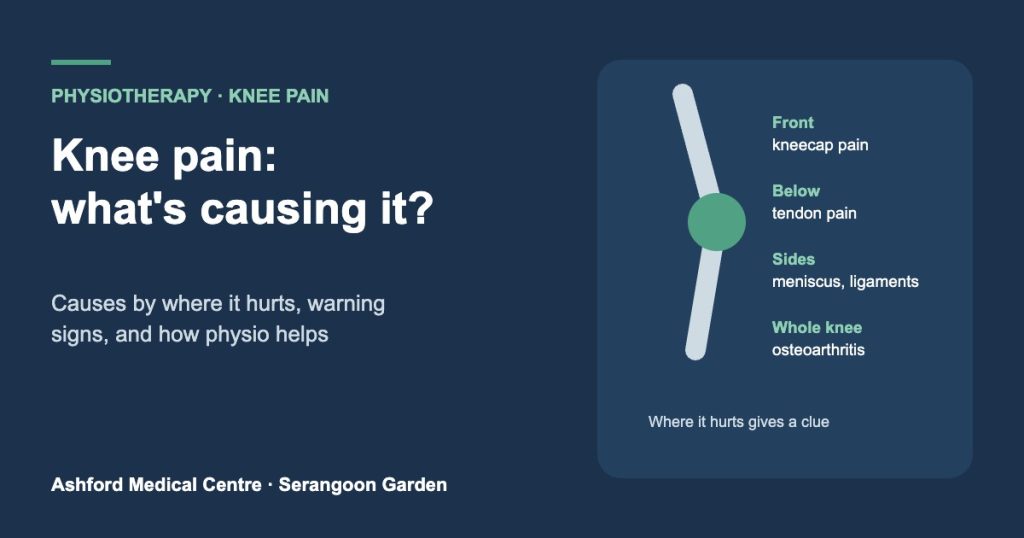
- Where the pain is, and how it started, gives a strong clue to the cause.
- Most knee pain improves within 6 to 12 weeks with exercise-based physiotherapy.
- Complete rest is rarely the answer. Keep moving within comfortable limits.
- See a doctor promptly if the knee is very swollen, locks, gives way, or you cannot put weight on it.
- Scans are not needed for most knee pain, but are useful in some cases. Your doctor or physiotherapist will advise.
Common causes, by where it hurts
| Where it hurts | Common causes | Typical pattern |
|---|---|---|
| Front of the knee, around the kneecap | Patellofemoral pain (“runner’s knee”) | Worse on stairs, squatting, or after sitting for a long time |
| Just below the kneecap | Patellar tendinopathy (“jumper’s knee”) | Pain when jumping, running or climbing; often stiff in the morning |
| Inner or outer side | Meniscus tear, ligament (MCL/LCL) sprain, osteoarthritis | Often after a twist; may click, catch or swell |
| Outer side, above the joint | Iliotibial band (ITB) pain | Common in runners and cyclists; worse running downhill |
| Whole knee, gradual | Knee osteoarthritis | Over 50s; stiffness in the morning or after rest, aches with activity |
| After a sudden twist with a “pop” | Anterior cruciate ligament (ACL) injury | Fast swelling, knee feels unstable or gives way |
Racquet sports such as padel and pickleball, running, and gym classes with lots of jumping and lunging are common triggers. See our guides to padel and pickleball injuries and HYROX injuries.
What you can do at home
- Keep moving, but adjust. Cut back on what clearly makes it worse (for example deep squats, stairs or running) and keep up activities that feel comfortable, such as walking, cycling or swimming.
- Ice or heat. Ice for 10 to 15 minutes can ease a new, swollen injury. Heat often helps stiffness from osteoarthritis.
- Simple painkillers. Paracetamol, or a short course of an anti-inflammatory if it suits you. Check with a doctor or pharmacist if you have stomach, kidney or heart problems.
- Start gentle strengthening. Straight leg raises, sit-to-stands from a chair and bridging are good starting points if they do not increase your pain.
- Watch your load. If you run or train, reduce distance or intensity by about a third for a week or two rather than stopping completely.
When to see a doctor
- you cannot put weight on the leg, or the knee looks deformed
- the knee swelled up quickly (within a few hours) after an injury
- the knee locks, catches or gives way
- the knee is hot, red and swollen, or you have a fever (this can be a joint infection and needs urgent care)
- the calf is also swollen and painful
- pain is not improving after 2 to 3 weeks, or wakes you at night
Our doctor can examine your knee, arrange an X-ray or MRI scan if needed, and prescribe medicine. Because our physiotherapist works in the same clinic, you can usually move straight on to treatment.
Do I need a scan?
Most knee pain can be diagnosed from your history and an examination. Scans are useful when:
- a ligament tear or significant meniscus tear is suspected after an injury
- the knee locks or keeps giving way
- pain is not improving with 6 to 8 weeks of good treatment
- there is a possibility of a fracture or another problem in the bone
Many people over 40 have changes on an MRI scan that are not causing their pain, so a scan is most helpful when it will change your treatment.
How physiotherapy helps
- Finding the cause: A full assessment of your knee, hip, ankle and how you move, squat and run.
- Settling pain: Hands-on treatment, taping and where helpful, SIS therapy or other electrotherapy.
- Strengthening: A progressive plan for the thigh, hip and calf muscles, which take load off the knee joint.
- Return to activity: A step-by-step plan back to running, sport or the gym, so the pain does not keep coming back.
Most people notice a clear improvement within 4 to 6 weeks, although building strength takes longer. After surgery such as a knee replacement or ACL reconstruction, see our page on rehabilitation after surgery.
Book physiotherapy for knee pain
One-to-one sessions with our AHPC-registered physiotherapist at 79 Serangoon Garden Way, from $200 for 45 minutes. No doctor’s referral needed, and our doctor is on site if you need a scan or medicine.
Frequently asked questions
Should I rest my knee completely?
Usually not. Complete rest can weaken the muscles that support the knee. It is better to reduce what aggravates the pain and keep up comfortable activity.
Is it safe to exercise with knee pain?
Generally yes, if the pain stays mild during exercise and settles within 24 hours. Pain that is sharp, or worse the next day, means you should reduce the load.
Can knee pain go away on its own?
Some mild knee pain settles within a few weeks. Pain that lasts longer, or keeps coming back, usually needs targeted strengthening to fully resolve.
Do I need a referral to see a physiotherapist?
No. You can book a physiotherapy session at Ashford Medical Centre directly.
Is clicking in the knee a problem?
Painless clicking is common and usually harmless. Clicking with pain, locking or swelling should be checked.
Will I need surgery?
Most knee pain does not need surgery. Surgery may be considered for some ligament injuries, certain meniscus tears that cause locking, or severe osteoarthritis that has not improved with other treatment.
Written by our physiotherapy team and medically reviewed by Dr Namthep Sachathep, Clinical Director. This article is general information and is not a substitute for an assessment by a doctor or physiotherapist.

